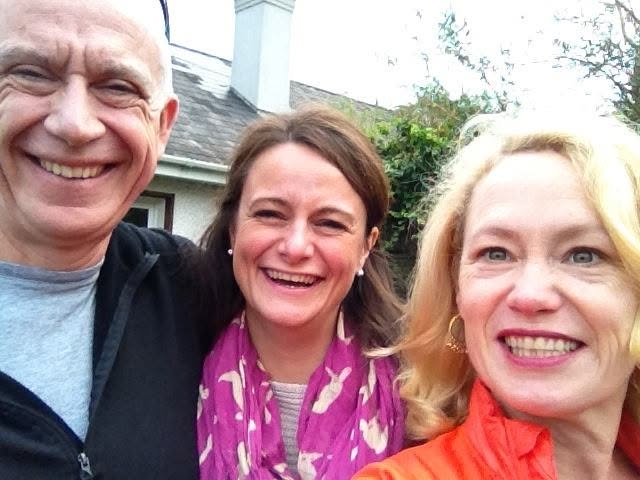
Jules Wyman died last month. She was 53.
Here one minute, gone seemingly the next. Cancer works that way sometimes.
I knew she’d had a hard summer. She was moving out of an office she loved in the heart of York, England, with a window that looked out over the Shambles. (If you’ve never seen it, picture a medieval street so narrow the buildings lean in like they’re gossiping to one another.) I figured she’d land somewhere new and keep going. That’s what Jules did.
Jules lived large. When she felt something was missing from her life, she didn’t wait around for it to show up. She did something about it. Wanted closer relationships? She bought a ticket and went and saw people, including me in Ireland. She traipsed across Europe and the United States. She went to Nepal. She did a 10-day silent meditation retreat, which would have killed me. Ten days without talking. They’d have carried me out on day two.
She was always experimenting. Try this. Try that. See how it works.
A little over a year ago, she had me on her podcast, “Coming to Your Senses,” and asked how I walked away from full-time employment and into writing. I wrote about that conversation back then. I’m sharing it again because it reads differently now.
It started on a blind date.
I was sitting across from some guy I’d met on Match.com when he asked what I did for a living. You would have thought I was a street walker, the way I started hemming and hawing. I was so mortified to tell him I was a chemical salesperson, selling industrial chemicals across a multi-state territory, that I kept dodging the question.
Obviously, he was confused. Why wouldn’t I want to tell him I sold chemicals? What was the big deal?
“Because I feel like I’ve outgrown it,” I finally blurted out. “I’m embarrassed that I’m still in chemistry when I’m not meant to be in chemistry.”
That moment of raw embarrassment changed the trajectory of my life.
Here’s what I’ve learned: the negative emotions we want to run from, like embarrassment, shame and jealousy, aren’t bugs in the system. They’re features. They’re telling you something isn’t working, something you’re not pursuing, some shift you haven’t acknowledged yet.
That blind date guy (not Walt, by the way, although I met him on Match.com, too) asked me what I’d always wanted to be. “I think I always wanted to be a writer,” I heard myself say.
Then he said something that sounded absolutely insane: “Well, why don’t you go back to school and study writing? You could go to Harvard.”
Harvard. At 37. With two kids, a full-time job, and living back home with my mother after my former husband had died. Everything in my life screamed that this was the wrong moment to make a change.
I did it anyway. I drove two and a half hours each way to take evening classes and got home at 11 or 12 at night. Within the first two weeks, I knew I was in the right place.
What I loved about Jules’s question was that it assumed there was a master plan. There wasn’t.
The path from that first Harvard class to building a business helping people write books was so ridiculously non-linear it’s almost embarrassing to admit. I flirted with teaching Vietnamese (there are maybe two people in America with a burning desire for basic Vietnamese conversation). I put up a website about drawing healthy boundaries while having the sketchiest boundaries on the planet.
It was all yes, yes, yes to opportunities I had no business saying yes to. Someone heard I ran a local writing workshop and asked, “Can you teach people how to write a book?” Sure, I’ll figure it out. Then one of those students asked, “Can you work with someone one-on-one?” Yeah, I can figure it out.
The key phrase is “I can figure it out.” I wasn’t saying that at 20 or 30. Back then it was more like “I hope somebody else is going to take care of it for me.”
I have to be honest about something most people don’t talk about: I had a financial safety net. Whether I made $360 every six weeks or $36,000, it didn’t matter, because I had support underneath me. I could say yes without knowing how things would work out because I wasn’t worried about the kids not eating.
Not everyone has that luxury, and I’m not going to pretend otherwise. If you’re driving Uber or waiting tables while trying to build something, you may need to be more strategic about your yeses and nos.
But one thing applies universally: you have to be willing to start before you know how it’s going to pan out.
On the podcast, I talked about growing up in a household where one minute everything was falling apart and the next minute everyone was sitting around the breakfast table acting like nothing happened. On and off switches, no obvious fixing.
I had to learn that everything worthwhile involves process, whether it’s training for a marathon, building a business, or figuring out who you are. You stick with something when you’re completely unsure how it’ll turn out. You begin anyway, even when you don’t know if it’ll be worth the time, money, or energy.
You’re aiming for Everest Basecamp in Nepal and you end up in Tibet. But the journey to Tibet changes you in ways you never bargained for. (Jules actually went to Nepal. Of course she did.)
What fascinates me most is how people think. I’m endlessly curious about why people do what they do, what’s driving them, what need they’re trying to meet. Jules was the same way, which is probably why that conversation went where it went.
Part of this comes from being completely puzzled by myself for years. I was a hot mess through my teens, twenties, and probably into my early thirties. Not the girl you’d bring home to mother. I’d do crazy stuff and then wonder, “What the hell was I thinking?”
So I started asking other people: What do you think? Why are you doing that? What do you see when you look at this? I realized I was an interpretation chamber, seeing things in ways that confused everyone around me, including me.
Now, when people start telling me their stories while we work on their books, three stories in I’m saying, “Actually, let’s go back four stories, because that’s where everything really starts. That’s your why, the power behind everything you do.”
If you’re in your twenties or thirties and think you’re a complete and utter shit show who doesn’t know what you want to do, here’s something Jules said on that podcast. I’m in my sixties, she was in her fifties, and we were both only just starting to feel like we understood life a little bit.
She didn’t get much longer to enjoy that understanding.
So pay attention to the embarrassment, the shame, the feeling that you should have it all figured out by now. Don’t run from those feelings. They might be pointing you toward something you need to go after, and you may not have as long as you think.
It won’t be a straight line. It’ll be a squiggly mess that somehow gets you where you need to go, even if that’s not where you planned.
You can listen to my conversation with Jules on “Coming to Your Senses” right here. Go hear her voice. Then buy the ticket.