An author I’m working with sent me a message recently. He’d stayed up way past his bedtime feeding his chapters to AI, one after another, and asking what it thought. (I’m not judging. I’ve lost whole evenings to less. Doomscrolling, anybody?) Then he asked me two questions. How do you know which feedback is worth listening to and which isn’t? And once the book is drafted, what does final editing actually look like?
Good questions. Every writer runs into them sooner or later, and AI has only jacked up the volume by 950 decibles.
Here’s what I told him.
Once upon a time–because I believe we should all write like we’re drafting fairy tales– I ran writing groups. Each term my partners and I would give a little speech about filtering every bit of feedback a student got in class. That included feedback from the people who’d been there week after week, watching the book grow from scratch. Of course, some of the feedback they would receive would be useful. The useful stuff usually showed up as a pattern, when more than one person put a finger on the same sore spot. The rest? Well-meant, mostly. People want to help, so they offer something. That doesn’t mean you have to take it home with you. Drop that shizzle into the trash can, along with those “secret” candy wrappers, as you head out the door.
It’s also why I tell clients not to let anyone read the manuscript while they’re still writing it. Not your spouse, not your book club, not the colleague who “loves to edit.” And, for the love of God, not your mother. Even the kindest reader can throw a wrench in the works without meaning to. Wrenches are so not good.
I once had a ghostwriting client send her finished draft to a group of people in her industry, all of whom had written books of their own. They absolutely tore it apart. Why? Because it didn’t look like their books. Never mind that she and I had decided at the very beginning that we weren’t writing that kind of book. It didn’t matter. She spent weeks worrying that what we had wasn’t what they had. With all those opinions rattling around in her head, she lost her center. Did she even spell her name right? That’s how far gone she was.
The book turned out beautifully. She was thrilled with it. But she second-guessed her way to the finish line, and she didn’t need to. (I mean, drama is fun up to a point.)
This is why I spend so much time up front nailing down three things: who the reader is, what the core message is, and what that reader should walk away with. Touchstones, is what these are. Once those decisions are made, they become your filter. Without them, every new opinion sounds as valid as the last one. And the one before that.
It’s what keeps your book on dental care from morphing into a Freudian study of millennial sex lives. (How the f*ck did we get here?!)
It’s also why I get a little twitchy when too many collaborators pile in during development. A team can help, sure. But if everyone isn’t working from the same song sheet, things slow to a crawl. A branding specialist, for instance, will have plenty to say about how an author is positioned. That’s their job. But a book covers only part of who you are and what you’re about. Add in your business coach and your bestie, and you might as well throw in the towel.
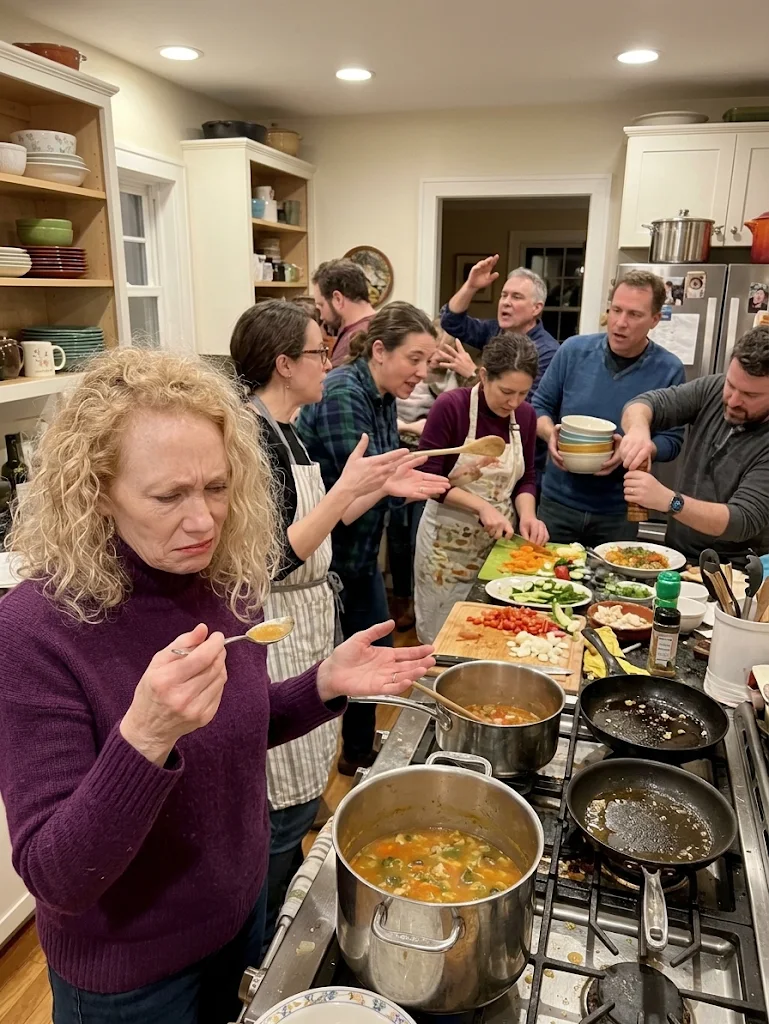
Too many cooks in the kitchen spoil the broth is an adage for an excellent reason.
None of this means the foundation of a book is set in concrete. Going back to refine the outline lets you change course by ten degrees and still hold the line. What it protects you from is the book that tries to contain everything you’ve ever known. (You know the one. Four hundred pages, and nobody makes it past chapter three.) A good book has a scope readers can actually take in and use.
Which brings me to AI.
AI is just another reader who hasn’t seen the whole book. You can feed it the outline and the touchstones–the core message, target reader, and reader outcome you’ve preset– and it still won’t know which stories you’re saving for later chapters, what you’ve already covered, or what should and shouldn’t come back around as a drumbeat. It might be looking at half the book plus a heap of your other material that may or may not belong in it.
It sounds smart. It isn’t always right.
I learned this the hard way. (Well, the mildly embarrassing way.) A company sent me an AI-generated visibility report for my website, chock-full of keywords my SEO manager was supposed to add. I was thrilled. Look at all the work it saved me! Then I actually read the thing. Half of it was dead wrong. Several of the keywords would have drawn people who were afraid of conflict. Why on earth? Because I’d once written a very popular blog post that used one of those words, and that post had nothing to do with writing, publishing, or the clients I want to serve. Lovely people, I’m sure. Not my people.
So I went through that report line by line and asked myself what I was really trying to do. I went back to my business touchstones and tossed everything that only sounded smarter than me.
That’s how I work with AI on a manuscript too. And yes, I use it. I push back. I disagree. I ask questions. I go back to what we’ve already decided and forward to what’s planned for later chapters. When something doesn’t sit right, I make it explain itself. It takes multiple drafts, with a lot of writing by hand in between. I’m not even going to get into the detailed prompting that has to take place.
But that only works because the book’s scope is already settled. Every chapter rests on a long record of decisions already made. Without that record, AI is just one more confident voice in the room. And that room is crowded enough.
Now, his second question. Once you’ve got a complete draft, revision begins. This is still the author and editor’s work. It means finding places to expand without throwing off the book’s balance. Tightening wording so it says exactly what you mean. Adding camouflage where a story needs more of it. (Your ex will thank you.) Building bridges between ideas so the reader never has to make a cognitive leap. Swapping a story for a stronger one when we’ve got it.
The goal is a manuscript that’s ready for a copyeditor.
That’s where the publishing process really begins. A good copyeditor refines further. They move paragraphs if needed, add the bridges we missed, hunt down overused words, and line edit. From there, the book goes through several more rounds of editing and proofreading before anyone calls it final.
So how do you use AI? Where is it good, and where does it fall short? Where do you need human judgment, and what do you have to ask to get what you want?
It’s the same answer as with any feedback, whether it comes from a writing group, a colleague, or a machine. Decide early who your book is for, what it says, and what it does for the reader. Then let those decisions do the filtering. Listen for patterns.
Let the rest go. Even when it sounds smarter than you. Especially then.