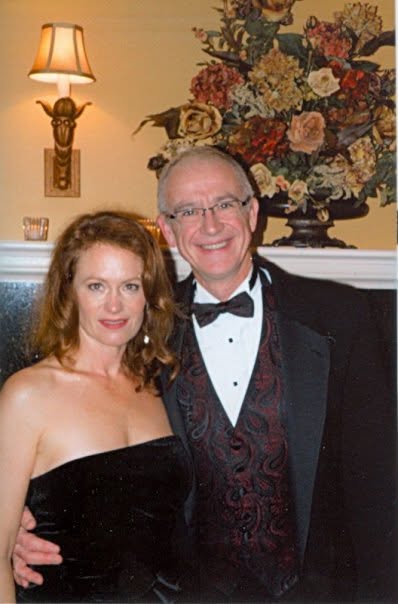
Walt has been telling the story of how we met for twenty-one years, and he has never once gotten it right.
His version: he was on Match.com, scrolling, and he came across a woman whose profile claimed she enjoyed a little black dress as much as she enjoyed Gortex. That was it. That was the line that got him. He tells this at dinner parties. He tells it to clients. He tells it with fondness, the way you’d describe a dog who does one impressive trick. Like walk on its hind legs singing “Mandy”.
I never once said that.
What I said was that I liked Gortex, which is true, because Gortex is a miracle of engineering and I’ve been dry in weather that had no business letting me be dry. But enjoy it? Nobody enjoys Gortex. You’re grateful for Gortex the way you’re grateful for a good snow tire. Who the f*ck enjoys their snow tires?
And a little black dress. Listen. If you’ve ever actually worn a little black dress, you know that enjoyment is not the sensation in play. You’re holding your stomach in, even if you’re wearing Spanx, an invention from hell. You’re calculating how many hours remain until you can take the thing off and put on a ratty pair of sweatpants. Enjoyment, my friend, is not top of mind.
But he likes his version, so he keeps it. Because he’s Walt.
Here’s my objection to it, though, and it isn’t really about the Gortex. It’s that his story starts too late. The interesting part happened a year or two before, and it had nothing to do with him.
Twenty-twoish years ago, I took my first vacation alone. A week-long bike tour in southern France. And despite my years as a traveling salesperson, I’d never liked going to the movies by myself, or eating dinner alone at a restaurant, because I didn’t want to look like a loser who couldn’t dredge up a single soul to join her for an outing.
So sauntering off to Europe without my kids or a lover in tow felt daring. Scary.
Sick of caving to the expectations and demands of others, vaguely dissatisfied, I just knew I was ready to do the thing I wanted to do, which was ride a bike hard through a country I’d never visited.
I left my children with my mom, and my boyfriend—an underemployed man I didn’t really like—on the curb, and I hopped the plane not knowing what to expect.
A couple of things happened while I was in France.
First, I discovered that I absolutely loved being on my own. That what I’d been afraid of was what I needed most.
Each day I’d bike the 40 or so miles at my own pace—sometimes chatting with other tour members, sometimes losing myself in the world around me—then return to my room, where I lingered in the narrow bathtub with a book until it was time to join the group for dinner. For once in my life, I didn’t feel compelled to entertain anybody but myself. The release from that responsibility left me light. Self-contained.
Second, I met a couple that totally changed my view of marriage, an institution I had come to equate with a leg in a bear trap. Which sort of explains why, for the previous twelve years, I’d dated an assortment of ridiculous and/or unavailable men.
Always interested in the dynamics of happy couples, I studied the two of them over several days. Sometimes they’d ride along together; sometimes he’d dart ahead and hang with the fast bunch. Regardless, there never appeared to be hard feelings or disappointment, just pure delight in their individual experiences. The expectation that they stick together at all costs, adjust their pace for the other’s comfort, didn’t seem to be part of their deal. To someone who believed that a conflict-free relationship required doing exactly what the other person wanted no matter how difficult or unpleasant, this was a novel concept.
Then came the afternoon in the square.
I’d tripped upon the two of them sunning themselves like cats at an outdoor café and joined them at their insistence. We swapped stories. They’d been married over 40 years. He was an M.D. who taught at U-Michigan. She was two courses shy of a PhD. I could feel their connection, their mutual satisfaction.
Then an attractive waitress came to clear our plates.
“Really, darling, you’re old enough to be her grandfather,” the wife said, in response to his open interest in the girl and his attempt at flirtation. “You’d have better luck with her.” She pointed at an elderly woman with a harelip lumbering past.
The two of them laughed, elbowed each other good-naturedly, then picked up the conversation where we’d left off. No harm, no foul.
Sitting here now, I’m still trying to name why that small exchange landed on me the way it did. It doesn’t seem the least bit odd anymore. I suppose I had yet to feel that secure in myself, or in a partner. I couldn’t imagine being that carefree. Enjoying the charms of a stranger just because I was in France and it felt good to be loved and alive. Perceiving no threat.
In my ten-year marriage to a very traditional Arab, flirtation wasn’t fun and innocent, it was an insult to honor, which bought one SERIOUS trouble. And then, when I up-leveled to dating a married man—someone who had demonstrated the proclivity to stick his privates into anything with a pulse—flirtation was a sign that I was about to be replaced by someone far, far cuter.
How wonderful to love someone and not be scared of making a mistake. Of driving them off with your needs and wants. Of losing them to a waitress.
How wonderful, how possible, this not-trying-so-hard business.
I’ve since come across the idea, and I wish I could remember where, that we keep chasing unavailable people because their indifference confirms what we already suspected about ourselves—that we aren’t worth much—and that if we could just get the inaccessible one to finally love us, we’d retroactively have the parent’s love we never got. The simpler option, choosing someone who is actually capable of loving you, tends to get lost in the shuffle.
I’d been squeezing love from stones for twelve years. It’s a hobby, in its way. Time-consuming, no return on investment.
So I came home from France and got on Match.com, and this is the part Walt leaves out.
I didn’t find him because of a clever line in my profile. I found him because I finally knew what I was looking at.
He had posted no picture. Which meant he wasn’t leading with the thing most people lead with, which intrigued me.
He was clearly an outdoors person, and by then I knew that mattered more than it sounds like it should. I wanted someone who wanted to be tired at the end of the day for the same reasons I did.
He was raising kids on his own. Which meant I’d never have to explain why I couldn’t pick up the phone, or why a Friday had gone sideways, or why my children came first. He already knew. There was going to be no translating.
And he was a lifelong student. This isn’t a charming quality on my end so much as a requirement. I get gripped by ideas. I’ll talk about a thing I’m working through for forty-five minutes without checking whether the other person has left the room. To someone who doesn’t share that bent, I am A LOT. To Walt, I’m…well, I’m not going to say “normal,” because that’s a bridge too far.
Twelve years earlier, I would have scrolled straight past him. No picture, single dad, reads too much. I would’ve found someone mysterious and impenetrable. Emotionally unavailable, just the way I liked them.
But I’d sat in a square in France and watched a woman point her husband toward an elderly stranger and laugh about it, and something in me had rearranged.
Tomorrow, September 1, we’ll have been married nineteen years.
He’ll tell the Gortex story again. I’ll let him.