A friend called me a few weeks ago with a book problem.
He’s a coach. Successful, and busy in a way that makes me tired just hearing about it: on stage one weekend, coaching in Toronto the next, Chicago after that, a podcast squeezed into whatever’s left. I mean, good Lord! For two years, he claimed, he’s been building a philosophy he cares about more than anything else in his business. It’s the thing he wants to keep exploring for the rest of his live long days.
And he’d written the book. Sort of.
I’ll give him this, he had decent instincts. He’d picked a model, a series of short, punchy books by a business thinker he admires. He sketched out his framework, handed it to some nice AI buddy, and asked it to write like that guy. It did. He got to what he called 80 percent. (I’m betting it was less than that, but I lean cynical.) Then he went and sent it to a couple of people he trusts, and they confirmed what his gut had already been telling him. “Dude, it reads like AI. The chapters are clunky. There’s no heart.”
Mmmm-hmmm.
“I’m at a crunchy, don’t-know-what-to-do point,” he said.
I hear some version of this every week now. And I don’t exactly get out much.
The thing is, when someone tells me about their book, I’m listening for three things while they unburden their soul. Who is it for? What’s the one idea they’re arguing? What’s different for the reader by the last page? Those are the target reader, the core message, and the promise, in case you didn’t know. Everything else gets built on those three. Without them you’re flailing, no matter how good the sentences are. Think: Life guards best be on high alert.
So I asked who the book was for.
Ambitious, purpose-driven entrepreneurs. Fine. That’s a reader.
A few minutes later, however, it’s also his son and his son’s friends, young men in their twenties who’d told him they want to be men and don’t know how anymore. And also, honestly, everybody. “This sounds so cliché,” he said. “It’s going to save the world.” Then, chagrined, he laughed, because he knew. And he knew I knew.
Here’s the problem. The story you tell a founder who wants to grow with less friction is not the story you tell a 25-year-old who feels like he has no place in the world. The pain is different, the want is different, and so is the transformation. Write to both and the book has to skitter across the surface so it doesn’t lose either one. You end up saying jack shit to anybody. None of this is fun to read, and it sure isn’t fun to write.
That isn’t an AI problem. But AI makes it invisible.
AI will happily write to everybody, good doobie that it is. It’ll produce clean, confident, grammatical paragraphs aimed at no one, and they’ll look finished. (Provided you don’t read closely, or run it under the nose of an editor.) That’s the bear trap. A messy human draft announces something’s wrong in no uncertain terms. A polished AI draft hides it. Be vague as fuck about your reader and AI will match you, word for word.
Then—oh, don’t get me started—there are the stories.
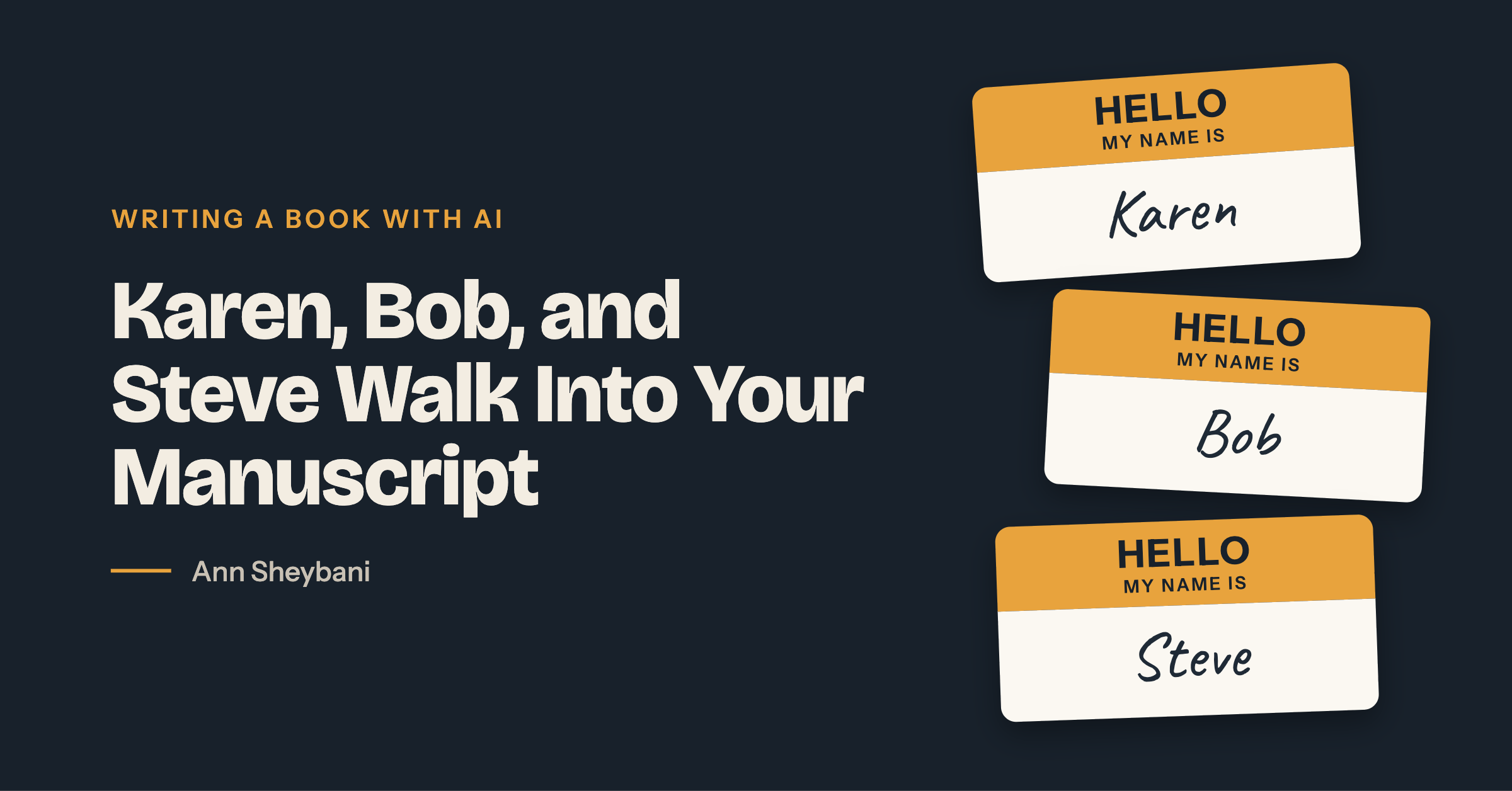
Ask AI for a story and you get one paragraph about a woman named Karen who struggled with something until she discovered the framework. Ask again and it’s Bob. Ask a third time and it’s Steve, struggling with the same something-or-other and making the same blessed discovery. It’s the most generic thing on the planet, and readers can smell it from Fargo.
Listen, I’m not anti-AI. I use it every day. But I never ask it to invent my stories. I bring the stories. I bring the client who did the opposite of what she should have, and the thing I got spectacularly wrong at 22. Then I go back and forth with it, sometimes eight drafts on a single chapter. That’s true. That’s not. It’s more like this. No, closer to that. I don’t let go until I have something I can look at and say, “Okay, now I can slap some meat on the bones.”
I can only do that because I know what I’m after. I know what each chapter is supposed to do and what the reader should walk away believing. I know the job of every scene.
Here’s what a framework book actually has to do. It has to show the reader what they think is true right now, and the actions that belief produces, and the results those actions are getting them. Then it shifts the belief. Once they see it differently, the actions change on their own, and so do the results. That chain is the transformation the reader paid for.
AI can spit out the how-to all day. It can’t tell you what your reader misunderstands, because it doesn’t know who your reader is. You have to tell it, and to tell it you have to know.
Now here’s the part I have to watch in myself. Just so you know I’m not immune from this nonsense.
I want AI to take things off my plate, too. Of course I do. I have authors, deadlines, a business, a husband who, selfishly, wants to eat dinner at some point. But the second I hand off a task, I start to forget why I was doing it in the first place. The task gets done and the reason for it falls out of the car.
I’ve got some terrible news. You can’t be a passenger in this car. AI will drive. It’ll drive confidently and smoothly, just like your college boyfriend, with great posture, in whatever direction you point it. If you don’t point it anywhere, it’ll pick a direction for you, and that direction is the middle of the road, where every other crappy book is.
To make a long diatribe short…By the end of our call, my friend hadn’t written a single new word. He’d figured out that his book might not be a business tool at all. It might be a manifesto, a passion project he’d been trying to cram into a box built for leads and revenue. He said the conversation had put the joy back into the book.
Nobody had asked him who he was talking to. Not even the machine.
Except this here purveyor of joy.