I’m sitting here this morning listening to Walt in the other room. He’s on a Zoom call with one of his clients, and apparently the guy is reluctant to try something new. He wants to cling to his old business habits because, as my mother used to say, “Better the devil you know than the devil you don’t.”
Meaning: he’s reluctant to head into the unknown, to do something unfamiliar because he can’t gauge the results. He’d rather stick with mediocre certainty than risk looking like an idiot.
I get it. I hate being a beginner. I hate entering the unknown. I like my habits, my same old same old, because—well—they’re comfortable. Over the years, I’ve established a level of expertise in certain areas. The results I get aren’t half bad if I do say so myself. Of course, they won’t get me to the next level—new level, new devil—but I can’t complain. At least I know what I’m doing.
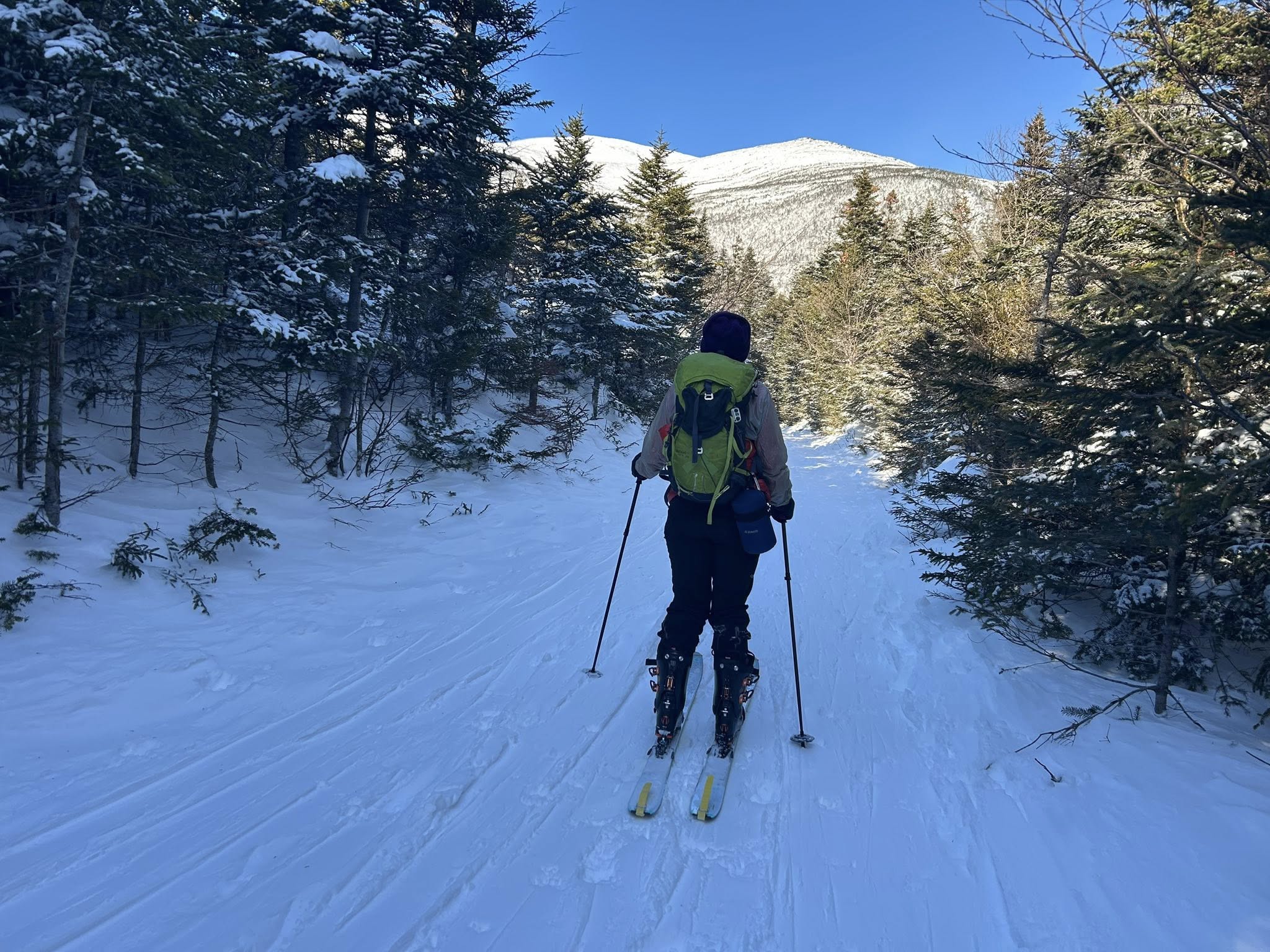
This year, Walt and I decided to take up backcountry skiing.
OK, let me correct that. I didn’t decide this. See above. Walt did. He got it into his head that it would be awfully fun to slap some skins on a set of skis, traipse uphill into the mountains, find a trail full of rocks, river crossings, and random trees, and ski down it. No grooming. No guarantee that you’re not going to hit a boulder or a spruce and kill yourself. Absolutely no ski patrol to rescue your ass when you get injured.
I’ve got to tell you, I hated it.
Our first time out, I stood at the trailhead fumbling with the skins—these strips of synthetic fur you’re supposed to stick to the bottom of your skis so you can walk uphill without sliding backwards. My fingers were numb. The adhesive wasn’t cooperating. Walt was already twenty yards ahead, and I was standing there like a toddler who couldn’t figure out her own shoelaces. Then came the bindings—these fiddly little mechanisms you have to twist one way to walk uphill, another way to ski down. Click your heels in wrong, and you can’t turn. Which I discovered the hard way, careening toward a stand of pines with all the grace of a shopping cart with a broken wheel.
I felt like an idiot. Falling, crying, asking Walt for help—who was having enough trouble on his own. I wanted to throw those skis in a snowbank and hike back to the Subaru.
And then, a few “adventures” in, somehow it all clicked into place.
I was skiing. Actually skiing. Enjoying myself. Feeling the thrill of adventure rather than panic. Had I not been browbeaten through the process, I never would have gotten to this point—where I can hardly wait for another dump of snow, to try a new trail, to see what I’ve got in me.
The same dread takes me over each time I start a ghostwriting project. Everything I put on the page looks like absolute drivel. I can’t find the thread. I have no idea how it will amount to anything worth reading, whether the client will be delighted or hire a hit man to take me out.
Every time I work with a client on their book, I witness the same process: doubt, a pile of ca-ca, anger, frustration, blame-tossing, the desperate need for more certainty when little exists. Those beginning stages are brutal.
And then the rhythm hits. Some expertise and skills develop. Before long, we’re all skiing down the hill like champions. We can hardly wait to get back on the page, to work the next chapter to completion, to make plans for the next book because we’ve become self-proclaimed bad asses. (Note the royal we.)
So if you’ve been talking about writing a book but—god—who wants to be a beginner and suck for a good long time?
This message is for you.
I feel you. But it’s going to be more than OK; it’s going to be worth it.