Back in the day, Walt and I would drive to the local Citgo on Sunday mornings to buy the New York Times. The paper was as thick as my arm, stuffed with the Magazine, the Book Review, and a fistful of inserts. From there we’d head to LaSalle’s, a family-run restaraunt where the locals gathered around big round wooden tables, drinking coffee and yakking. We’d grab a spot in the way back, where no one could see us, and spread the paper across the table. I went straight for the book reviews. Walt went straight for the op-eds.
The smell of the newsprint. The ink on our fingers. The sense that the whole world was laid out in front of us, ours to explore at our leisure. Bliss!
We still subscribe to the Times, online now, though scrolling on a screen isn’t half as satisfying as spreading newsprint across a table. We still read the op-ed page and the Book Review. These days I’m in the op-eds constantly, because that’s where I find ideas, books, and authors I’d never cross paths with any other way.
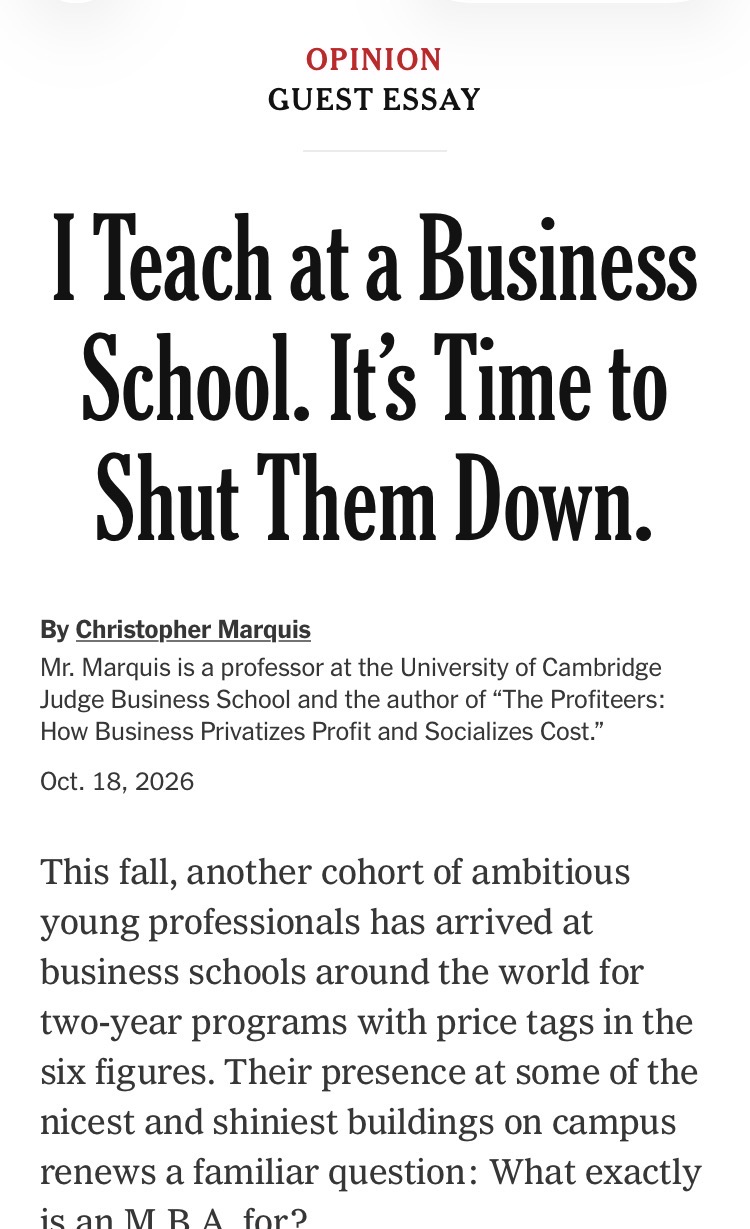
The headline is what hooks me, the way it’s supposed to. “I Teach at a Business School. It’s Time to Shut Them Down.” Well, now I have to click, if only to see how the author plans to back that up. My interest spikes when the idea brushes up against a book proposal or a book I’m ghostwriting. Then I read the bio at the bottom, and half the time, the author has a book about to come out. I track it down on Amazon, read the sample, and just like that, I’ve bought it. Often I buy everything else that author has written, too.
Think about what just happened there. Nobody ran an ad at me. Nobody sent me a launch email. A stranger made an argument, it stuck, and I went looking for them.
That’s what a byline does.
When I met Paul Martin Jensen and his partner Carolyn Barnwell and understood what they did for a living, I thought of you right away: those of you writing a book, about to write one, or staring down the promotion section of a book proposal. (That section makes grown adults cry when their platform is thin. I’ve seen it.)
I also talk to plenty of people who’ve tried writing an op-ed on their own. They wrote something they believed in, sent it to their dream publication (who knew Wired was such a thing?), and heard nothing. Or got a polite no. And that was the end of it.
It doesn’t have to be. Paul has spent more than 15 years guiding deep thinkers into earned bylines (not paid placements) in the New York Times, the Wall Street Journal, the Financial Times, the Washington Post, Fortune, CNN, and many more. His clients have included Fortune Global 500 executives, university faculty, and the sitting presidents of two countries.
Here’s what most people miss: a rejection from one outlet isn’t a verdict. It’s step one. And publication isn’t the finish line, either. Paul calls it the crack of the starter pistol. That’s when the piece goes to work for you, opening doors to speaking invitations, TV appearances, policy conversations, and yes, book deals. He has a friend whose Harvard Business Review piece on silence turned into a major book deal, translated into 11 languages.
There’s a newer reason this matters. AI search tools like ChatGPT and Gemini are quietly sorting everyone online into categories. Post on LinkedIn every day and you’re tagged a “content creator.” Earn a byline in a major publication and you’re tagged an expert. The expert label sticks. The social posts fade.
And then there’s the part that stops most people cold: a good op-ed takes a stand. Taking a stand in public is scary, especially if you spent a career learning to say nothing anyone would remember. That’s where Carolyn comes in. She helps people get past the fear so they can write what they actually think, not what feels safe.
So I’ve asked Paul and Carolyn to sit down with us for a free live Masterclass on Thursday November 5, 2026 at 2 PM ET. They’ll share what op-eds have done for their clients, what editors are actually looking for, and the mistakes that sink most first attempts before an editor ever reads past the headline.
You don’t need a finished book to get something out of it. If you have a body of work and opinions you’d defend at the dinner table, you have op-eds in you. If you do have a manuscript, I’d bet there are ten hiding in it.
Because someday, someone will be sitting in the back of a restaraunt (or, let’s be honest, scrolling on their phone), and your headline will stop them cold. They’ll read your bio. They’ll find your book.
And they’ll buy everything else you’ve written, too.
P.S. Walt still reads the op-eds first.