Sometime back in May, Walt got it in his head that we should renovate our kitchen.
Now, I should mention we’d bought this house sight unseen during the pandemic—intended as a home base for our trips back from Ireland, with Airbnb covering the mortgage the rest of the time. Instead, we moved in and stayed. And after three years of living with a kitchen straight out of the 1980s, Walt had had enough.
Me? I’m too oblivious to notice these things. And after two previous kitchen renovations, I wasn’t about to sign up for more of that particular brand of torture.
From the get-go, this project had all the harbingers of doom.
First, we cleared out the cabinets and stored everything in the guest bathroom and spare rooms. (Picture telling your friends they can’t stay with you because there’s no room to sleep—not because of houseguests, but because every surface is covered with plates, glassware, and canned goods.) Then deliveries got delayed. And delayed again. For two months we rummaged through boxes looking for a spatula, a coffee mug, the colander we swore was right here yesterday.
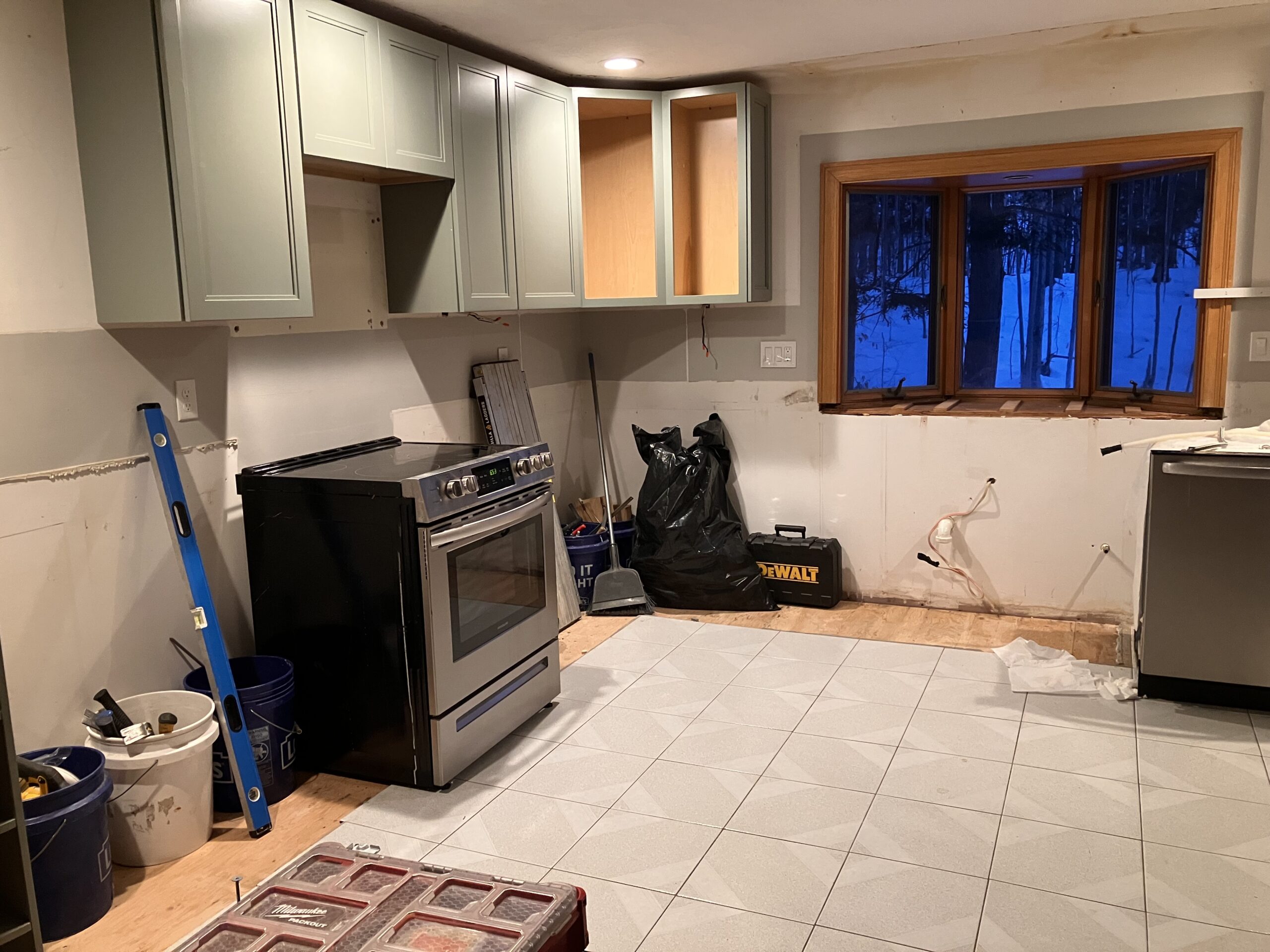
Finally, demolition day arrived. Two young bucks showed up and started ripping out cabinets and countertops and throwing them over the balcony. Dust flying everywhere. The sink disconnected, the stove sitting in the middle of the room like a confused guest at the wrong party. Holes in the walls where trim work once covered them. Half-painted surfaces exposed. Wires.
By day two, they’d moved the kitchen island to where they thought it should go, exposing four feet of naked floor.
Four feet that weren’t supposed to exist.
Someone had measured from the wrong side of the kitchen island.
One mistake. Made early. Buried in the paperwork. And now we were choosing between ordering another cabinet to fill that gap—six more weeks, minimum, more with the holidays—or investing in new flooring AND accepting a smaller kitchen footprint. The demo guys stood there with their work papers, wanting sign-off despite the gaps, the missing trim, the handles that hadn’t arrived, and a sink that wasn’t connected to anything.
Walt was on the phone with their supervisor. Let’s just say the conversation was educational for everyone within earshot.
Me? I was already mentally washing dishes in the courtyard like I did when I lived in Iran, cooking on a portable gas stove, resigned to another year of chaos. I assume the worst. Walt fixes it all.
We’re not even going to discuss the countertop people, who decided the mis-measurement would cost us an additional 46% over quote. Three additional square feet equals 46%? We’re still trying to figure that math out.
Poor Amanda, the saleswoman over at Lowe’s, has been beside herself. She’s been trying to keep all the vendors moving in the right direction AND handling Walt—who, I believe, should be hired by customer service trainers everywhere. If someone can appease that man without losing their everlovin mind, they should move straight to the head of the class.
But here’s the thing about mis-measurements: they don’t announce themselves upfront. That installer didn’t walk in on day one and say, “Hey, these numbers are off.” He discovered it on day two—after the old cabinets were gone, after the walls were exposed, after there was no turning back.
This is exactly what happens when writers skip the outline.
You start building. You’re making progress. Chapters are piling up. And then somewhere around draft two, you realize the whole thing is measured wrong. Your premise doesn’t support your conclusion. Chapter four should come before chapter two. That case study you loved doesn’t actually fit anywhere.
And now you’re choosing between ordering new content to fill the gaps (six more weeks, minimum) or accepting a smaller book than you envisioned. Neither option feels good. Both cost more than you budgeted—in time, in energy, in the particular despair that comes from ripping out work you thought was finished.
Your outline is your measurement. Get it wrong, and you’ll be standing in the rubble wondering how a three-month project turned into a year-long ordeal.
This is why I’m such a lunatic about blueprints.
When you build brick by brick—one story, one case study, one framework at a time—you need to know where those bricks are going. You need measurements you can trust. Otherwise you end up with four feet of naked floor and no good options.
That’s exactly why I’ve included templates in this book for the most common prescriptive nonfiction structures. These aren’t vague suggestions about “finding your voice” or “letting the story emerge organically.” They’re architectural blueprints. They tell you: here’s what goes in chapter one, here’s what chapter five needs to accomplish, here’s how the pieces connect.
You wouldn’t let your contractor eyeball where the island goes. Don’t eyeball your book structure either. Measure twice. Build once. And for God’s sake, measure from the right side of the island.