
The Zoom rang at 7 AM my time. Evening in Bali.
Kris sat in candlelight — she doesn’t like overhead bulbs after dark, never has.
We hadn’t talked in a couple of years. She’s a former client, a fellow traveler in the long messy business of writing a memoir, and a friend I love. (I want you to know that upfront, because this is not a takedown post.)
She started telling me about the book.
The book she’s been writing for ten-plus years.
Now, before you ask: yes, she’s been writing the whole time. No, she hasn’t been faking it. She has, by her count, somewhere north of 180,000 words — roughly 720 pages of double-spaced manuscript — stacked across multiple Word docs and now being lovingly fed through ChatGPT for refinement.
She’s serious. She’s diligent. She’s lived a hell of a life.
So why isn’t there a book?
Because everything I heard her say that morning I’ve heard from clients writing business books, prescriptive nonfiction, leadership memoirs, spiritual books, and pretty much every other genre on God’s green earth. The disease is the same. The cure is the same. Most people just don’t want to take the medicine.
Here’s what I heard.
1. She has too many themes, and she refuses to choose one.
When I asked Kris what the book was about, she answered for ten lonnngggg minutes. The book is about being a highly sensitive person in environments not built for her. It’s about being a Type-A high performer who never listened to her body. It’s about her spiritual journey. It’s about her father’s cancer. It’s about losing her home in a fire. It’s about a teacher who taught her about vibration. It’s about Bali.
That’s not a memoir. That’s a binder.
A memoir, like a novel, requires a container. And a theme isn’t a topic — it’s a filter. Once you choose it, every scene gets held up against it: does this story belong inside the container, or doesn’t it? The stuff that doesn’t belong isn’t bad. It might be wonderful. It might be the seed of your next book. But it doesn’t belong in this one.
Kris resists choosing the filter, because choosing means letting go. And she loves what she’s written.
I get it. So did I, when I was working on my own memoir with ten themes I was juggling like flaming pigeons. (Oh, can you imagine?!) But here’s the truth: until you choose, you can’t shape. And until you can shape, you don’t have a book — you have an archive.
2. She is modeling six other memoirs at once.
She wants the literary mortality of When Breath Becomes Air. The structure of Eat Pray Love. The sensory immersion of Wild. The tight chapters of The Surrender Experiment. And a couple more I can’t remember, because at some point I just started counting.
Pick ONE.
I’m not kidding. I’m not being mean. Pick the one book whose shape you most admire, and use it as your map. Once you can deliver a draft that holds the shape of that one book, you can play. You can break rules with confidence. But you can’t break rules you’ve never followed. You’ll produce chaos and call it innovation, and your reader will close the book on page 12.
3. She is writing right up to this morning.
Kris told me she wants to include a chapter about Bali. About the burning rice paddies. About the construction noise. About the conversation we just had over Zoom.
This is the trap that keeps the container from closing. The writer is the protagonist. The protagonist is still alive. The story keeps adding chapters because life keeps adding chapters.
But a book is not a live feed. It’s a snapshot. You decide where the story ends. Then you write toward that ending.
This applies to every kind of book, by the way. The business author who keeps adding the latest framework, the latest case study, the latest LinkedIn lesson, until the manuscript is six years old and still “almost done.” The leadership coach who can’t release her book because last quarter she had a new realization that obviously has to go in. The expert who’s waiting until she figures out the final thing she has to say.
Darling, you’ll never figure out the final thing. The final thing arrives the day you die, and at that point publishing becomes someone else’s problem.
Pick a stopping point. The book was true on that day. That’s enough.
4. She does not know what her protagonist wants.
Confused by the litany of events that is her life, the one she’s trying to capture on the page, I asked her, “Big picture, life-wise — do you know what you’re looking for?”
Her answer, almost verbatim: “I don’t think I have a thing that I’m looking for. I was looking for answers. But I’ve stopped with goals. I’ve stopped with vision. So… I don’t know what I’m looking for.”
This is a beautiful answer for a human being. It is a fatal answer for the protagonist of a book.
Every story — novel, memoir, business parable, client transformation case study — has an engine. The engine is the protagonist wants something. They want love. They want revenge. They want to be at the center of the circle. They want to lose the weight, save the company, climb the mountain, prove dad wrong, escape the fire. The wanting is what pulls the reader through the pages.
When the writer can’t tell you what the protagonist wants, the book has no engine. There’s nothing to push against, nothing to chase, nothing to fail at, nothing to triumph over. Just observation.
Kris is so far down the spiritual path of “no goals, no agenda, surrender to what is” that her narrator has nowhere to go. Each chapter ends, another begins, another version of self dies, another false summit is mistaken for an arrival, and the reader, who’s been watching all this, slowly closes the book and shuffles off to bed.
The good news: you don’t have to figure out what you want. You only have to figure out what the protagonist wants in the time period the book covers. That’s a much easier question. And it almost always exists, even when the writer can’t see it.
5. She thinks she needs more bricks.
Kris told me she’s a few months away from being ready to shape the manuscript. She still wants to write more raw material. She has more chapters about Bali coming in.
She probably does need a few more bricks. That part isn’t the lie.
The lie is the belief that more bricks will become a building. They won’t. Bricks become a building only when you stop making bricks and start placing them. Most writers never make that switch. They die loving their bricks, surrounded by their bricks, with no house.
I told her this, in slightly nicer terms. I think she heard me. We’ll see…
Now here’s the deeper thing I want you to take away from this — whether you’re writing a memoir, a business book, a spiritual guidebook, or a leadership manifesto.
There are two completely different books a writer can produce, and most people who’ve been writing for years on end have confused them.
The first is the book you write to understand yourself. Therapy on the page. The privilege of seeing your own life clearly enough to make peace with it. This book is finished when you are finished. No one else needs to read it.
The second is the book you write so a stranger can pick it up, follow what you mean, and walk away changed. This book has rules. A container. A filter. A protagonist who wants something. A beginning, a middle, and a stopping point that comes well before the writer’s actual death.
Both are valid. Both have value.
But they’re not the same book. They have different goals, different rules, different finish lines.
Kris has finished the first book. Several times over.
She has not yet started the second.
If you’ve been writing the same book for more than two years, ask yourself, honestly…
Have I chosen one filter, or am I trying to fit ten themes inside one cover? Am I modeling one book, or six? Am I still trying to bring the reader up to today, even though today keeps moving? Do I know what my protagonist wants? Am I still adding bricks, or am I finally placing them? And — be honest, now — am I writing the therapy book, or the reader book?
If your best answer is “still adding,” you don’t have a writing problem. You have a deciding problem.
Choose. Choose, choose, choose. Choose your theme. Choose your model. Choose your stopping point. Choose what your protagonist wants. Choose which book you’re actually writing.
The choosing will hurt. You’ll lose chapters you love. You’ll let go of a few selves you were rather attached to. You’ll accept that the book will not contain everything.
But on the other side of choosing, there’s a finished book.
On the side you’re standing on right now, my friend, there’s just more bricks.
Pick up the trowel.
P.S. If you are stuck in your own version of this — too many themes, too many bricks, no container, no clue what your protagonist wants — that’s exactly what an Hour of Power is built for. We sit down, I look at what you’ve got, and we choose. One theme. One model. One ending. You walk away with a container.
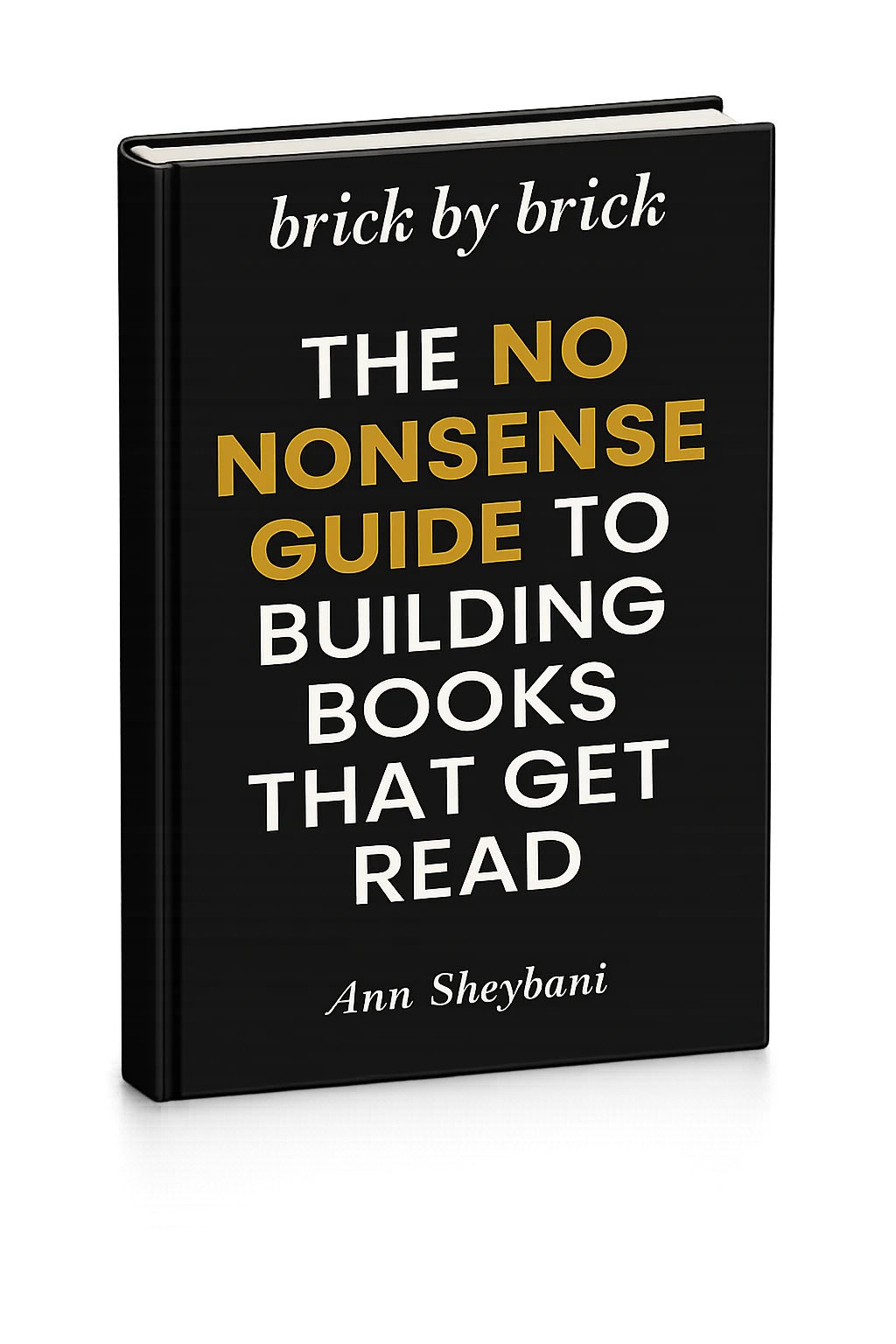
Or if you’d rather work through it on your own, Brick by Brick: The No Nonsense Guide to Building Books That Get Read will walk you through every step: