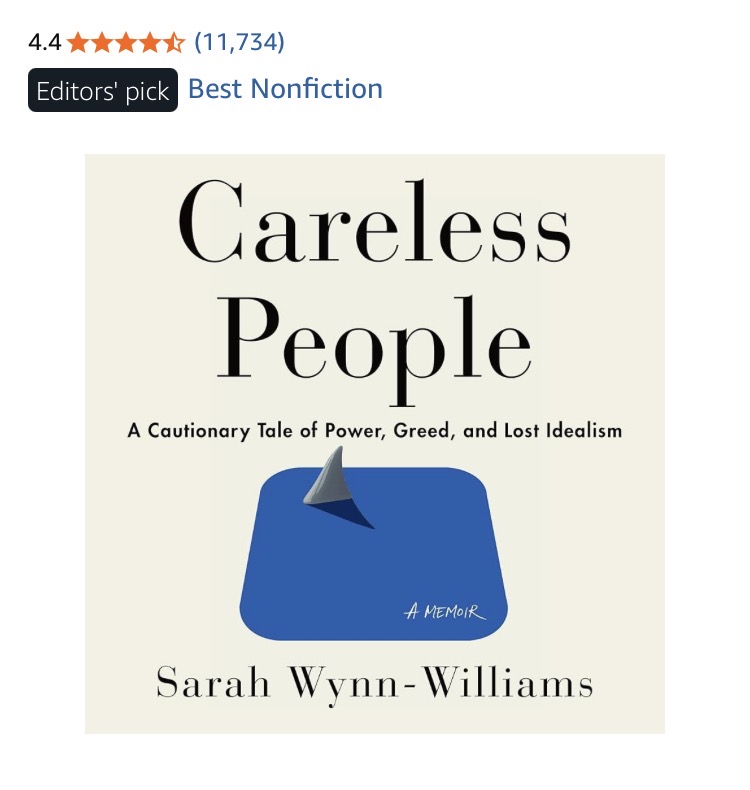
I’d heard about Careless People long before I finally cracked it open in the airport. It had been sitting in my Kindle alongside all the other fantastic books I swore I’d eventually get to. But once I started the memoir, I couldn’t put it down. Which was great, because I had ten hours ahead of me and no desire to work on a project.
If you know nothing about the book, it’s a tell-all about Facebook. The evolution of the company, its policies, Mark Zuckerberg, Sheryl Sandberg. Sarah Wynn-Williams, the author, worked as Facebook’s director of global public policy from 2011 to 2017, which means she was in the room. On the private jet. Prepping Zuckerberg for meetings with world leaders. Watching the sausage get made.
And holy crap, is it a page-turner.
Not to ruin any surprises, but Sheryl Sandberg is about as far removed from the persona she created in Lean In as you can possibly imagine. Zuckerberg comes across as a guy so obsessed with cracking the Chinese market that he was willing to build censorship tools for the Chinese government. There’s unaddressed sexual harassment. There’s a content moderation system so carelessly managed that a single Irish contractor—out to dinner without his laptop—was the only thing standing between a viral post and riots in Myanmar. Genocide.
I wasn’t eighty pages in before I started wondering how much money Meta spent trying to kill this book before publication.
Here’s the thing: we almost never get this kind of behind-the-scenes look at powerful companies. And there’s a reason for that. People don’t talk. They’ve signed non-disclosure agreements. Non-disparagement clauses buried in severance packages. Their careers are on the line. Their industry relationships. Their future earning potential. The people who get close enough to see the really crazy stuff are usually the same people with the most to lose by revealing it.
Which is exactly why Meta came for Wynn-Williams with everything they had.
When Meta caught wind that she’d written a book exposing the inner workings of the company, they weaponized it. They obtained an arbitration order prohibiting Wynn-Williams from promoting her own book. No interviews. No publicity appearances. No author circuit. They reportedly threatened to fine her $50,000 for every breach.
But here’s what Meta didn’t count on: the Streisand Effect.
The term comes from Barbra Streisand’s 2003 lawsuit to remove aerial photos of her Malibu mansion from a coastal erosion database. Before the lawsuit, the image had been downloaded six times. After news broke? Over 400,000 views in a month.
Meta’s legal action generated more publicity than any book tour ever could. Wynn-Williams couldn’t do interviews, but her publisher could—and did—promote the hell out of it. The story of the world’s most powerful social media company trying to silence a former employee became the story. Careless People sold 60,000 copies in its first week. It hit #1 on the New York Times bestseller list.
Meta essentially did Wynn-Williams’s marketing for her.
Reading this book, I couldn’t stop thinking about a project I worked on several years ago. Another tell-all. A young woman who’d written about her batshit boss at a hedge fund.
The stuff in that manuscript was the stuff of movies. Her having to fire or hire employees based on their looks. Hiding in a bathroom while on vacation so she could find her boss a yacht at the last minute. Making excuses when he disappeared in the middle of tense negotiations or market downturns, something he did for days on end.
And here’s the detail that stopped me cold when I read Careless People: both women were on the phone with their bosses while in labor. Doctors and nurses telling them to put the phone down. And they couldn’t.
Mind you, these women aren’t victims of circumstance. They’re the ones who make shit happen.
Here’s the problem with make-shit-happen people: the same drive that gets them into the room is usually what keeps them there too long. They’re so good at pushing through that they don’t stop to ask whether they should. They’re so focused on winning the game that they don’t think about what happens when they flip over the board.
When it came time to publish, my client changed her mind.
Even with her former boss’s identity disguised, she’d be blackballed in the industry. People don’t like it when you reveal how stuff really works behind the scenes. How much shit you actually have to eat to play that game. She understood what she stood to lose versus what she stood to gain.
She wasn’t willing to blow up her industry. So she killed the book.
Wynn-Williams, however, was willing. And she’s paying for it—with legal battles, with gag orders, with a company worth hundreds of billions of dollars trying to bury her. But she’s also got a #1 bestseller and an invitation to testify before the U.S. Senate.
Here’s what I learned from working on that hedge fund project: if you’re going to reveal people’s secrets—bosses, family, former friends—you better know how deep you’re willing to go before you start.
Because there will be pushback. There might be a lawsuit. There might be an arbitration order. There might be Thanksgiving dinners you’re no longer invited to.
If you’re thinking about writing your book anonymously? That’s a red flag. It’s probably a sign you’re NOT ready to deal with what comes after. That you stand to lose too much.
And that’s cool. Not every truth needs to be published—at least not yet.
But figure that out before you write the book. Not at the finish line with an unpublished manuscript and years of work sitting in a drawer.
The question isn’t whether you can tell the story. It’s whether you’re willing to burn it all down to do so.